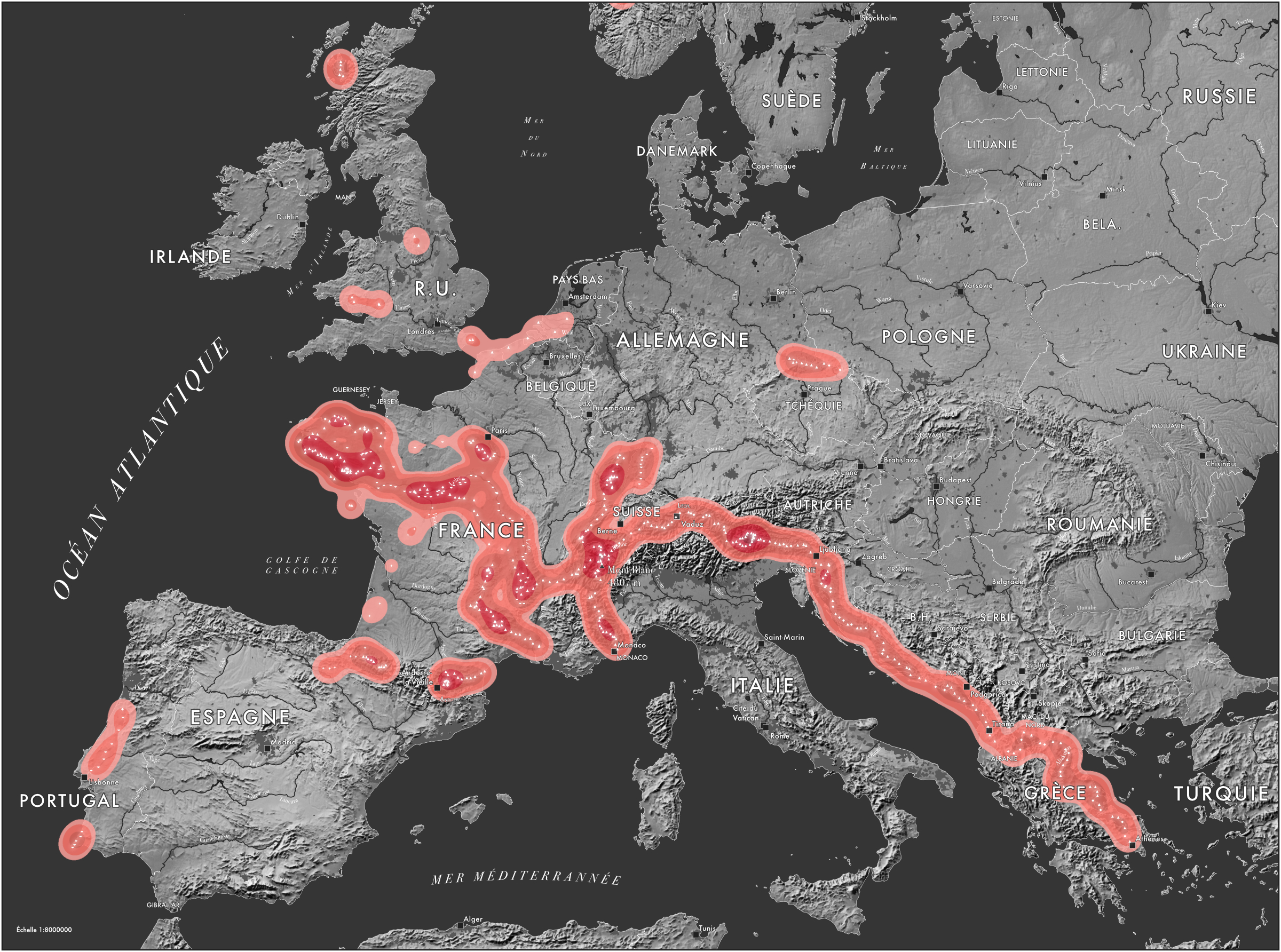
September 2024. Franck and Simon travel the roads of the United Kingdom to meet the men and women who once gave life to emblematic places in now obsolete industrial regions. From Kent to Yorkshire, passing through Wales, the photographer and the pen talk with personalities who tell their story and bear witness to a past full of meaning.
In this excerpt from Memories of Coal, Franck and Simon drive to the forest of Dean, a green setting nestled at the edge of Wales, to meet the freeminers and their artisanal mines.
🇫🇷 Lire cet article en Français.
—
🖋 The text was written by Simon.
📸 The photographs were captured on film by Franck ↗︎.
🔗 Support the campaign of Franck and Simon by contributing to the crowdfunding campaign ↗ from the complete reporting called Memories of Coal.
Memories of coal
This post is an excerpt from a long investigative work that gives rise, in 2025, to the publication of a written and photographed report: Memories of Coal.
Franck and Simon launched a crowdfunding campaign to support the printing costs of this 188-page report, written in French and English.
Support them by participating in the campaign ↗︎.


—
From the bucolic landscapes of Kent, Franck and I drove half a day to reach the border separating England from South Wales. Earlier during our stay, we had learned that the Forest of Dean, our destination, was known not just as a land of welcome, but as a singular place, a heaven for wizards in danger, cf. Harry Potter and the Deathly Hallows.
Beneath the forest’s hilly and wooded terrain, coal has been seeking impossible peace for millennia. Independent men, operating outside the bounds of industrial capitalism and holding a status no other miner in the country claims, dig into the earth under conditions that seem relics of another age.
In scattered villages among the woods, we stop in the hazy light of a café. Huddled over their mugs, the locals eye our foreign-registered car with curiosity. Meanwhile, Franck carefully lays out his gear on the table for a final lens cleaning. He detaches the prism from the camera to polish it thoroughly, blowing off dust and specks of mold and moss; he finishes by meticulously wiping the lens with a spotless cloth.
“You travelers?” a round-figured man with a shaved head approaches. His name is Billy. He’s chewing on a full English breakfast, beans, sausages, and fried eggs. At his side, two hefty Labradors sit at attention like soldiers, lost in dreams of meat dripping with grease from their master’s fork.
We share our project with him, this report on coal that’s had us gripped from the start. Mouth full, Billy suggests a few local spots : pubs, woodland walks, and, above all, the Hopewell Colliery, where “freeminers” lead guided tours.
“Freeminers aren’t like regular miners,” he tells us. “They work coal like craftsmen. You can’t just become a freeminer. They only exist in the Forest of Dean. Go to Hopewell, you’ll see.”
Swallowed by the shade of a mystical valley, Hopewell does indeed resemble a handcrafted mine. All round, the trees whistle a hymn of silence. Frantit crows caw. Industrial waste is piled high, and behind a small canteen filled with grey-haired patrons and relics from the days when the mine was still active, a tunnel cuts horizontally into the flank of a wild hill. The entrance, barely two meters wide, is crude, like a gaping, damp mouth. The rocky edges drip with moisture and humidity.
Standing at the doorway is a tall man. His name is Jason, and as a current freeminer, he’ll be our guide for the next hour. His surprising height makes me wonder what kind of contortions he must perform when working underground. He wears overalls, and his too-short trousers reveal brightly colored socks, a touch of eccentricity.
Before we step into the damp and unfeeling tunnel, Jason shares some background on his community. In a chant-like tone, he expands on what Billy had told us earlier. Freeminers from the Forest of Dean are a unique presence in the UK’s coal-mining world. They are independent craftsmen, outside the corporate mining sector, more like gold prospectors from the American West than the “coal-faces” of Germinal. In these woods, there are no chimneys or monstrous machines. Opening a shaft is a privilege held by a handful of freeminers whose code resembles that of a caste.
In 1838, the British government passed legislation recognizing the historical and traditional rights of freeminers. Jason, his voice careful and proud, lists the three inviolable conditions required to become one:
- You must be a man,
- You must be born in the Forest of Dean,
- You must complete an apprenticeship of one year and one day under an active freeminer.
Once these conditions are fulfilled, a man gains the right to dig his own “gale”, that is, legal permission to mine the region’s underground coal seams. In 2010, the law evolved to finally recognize women. They may now claim the status of freeminer, provided they meet the same conditions as men.
In the Forest of Dean, infrastructure is basic. With no colossal winding towers to lower workers a thousand meters underground, freeminers rely solely on the strength of their legs. Jason, slipping a helmet with a lamp onto his thinning head, just like those we’d seen in Kent, bends like an arched rib vault and leads us willingly into the darkness of the gale.
The sloping corridor, which our guide calls the “dipple,” descends into distant abysses I imagine inhabited by strange lantern-bearing creatures. We move in single file, one behind the other, clinging to a cold, damp railing installed for visitor’s safety. Ahead, the flickering glow from our helmet lamps light up the void. The temperature drops gradually, following the slope where our soles occasionally slip. Sounds, so rare they become precious, scatter with our breath when we stumble clumsily over the remains of an old rail.
Around us unfolds the void, a black, inert mass as unsettling as the agitated mind of a madman. Staring into the uncertain, I try in vain to picture Jason’s daily life. On days, he isn’t guiding curious visitors like us through the depths of his world, he navigates these corridors, barely held up by rusty sheet metal or wobbling pine trunks.
In active gales, the freeminers descend the dipple in groups of three or four for long hours they never count. True craftsmen, they don’t rely on fixed salaries. Only the coal-filled cart has value. As long as it’s not full, they keep picking away, tirelessly.
Jason stops at a landing where a new, deeper tunnel opens. The low ceiling naturally forces our backs to hunch. Shadows from our lamps flicker across the damp walls, echoing the silhouette of Quasimodo. In a corner, a coal-laden cart rests on worn-out rails; in another, a jackhammer lies abandoned.
Our guide points to a gouge in the rock, barely fifty centimeters high and about a meter off the ground. “This is where freeminers used to sweat out every ounce of their misery,” he says flatly. Crouching, lying down, bracing themselves, whatever it took, they were soldiers at the front. This gash in the earth was their war.
To endure this hostile battle, miners in the region have honed a precise sense of resourcefulness. Despite technical progress, they prefer combining available materials with their own ingenuity. Until quite recently, most tools were locally forged. The majority of support beams came from trees felled in the Forest of Dean, others were cut from old gas or oil tanks. As for communication, no radios, no phone lines. Instead, miners pulled on a thin rope to ring a bell above ground :
- Two rings meant send a cart,
- Three meant bring one up,
- One signaled danger: stop everything.
One of the visitors tries to lift the jackhammer. “Too heavy,” he says, dropping it as quickly as he picked it up. Jason chuckles, then mimics a few postures to show how it’s done: “Lying on your back? Just rest the machine on your foot,” he says, raising his. “If you’re squatting, rest it on your thigh,” he adds, tapping his own quads. But he also admits the beginner’s mistakes driven by masculine pride, mistakes he and others quickly corrected: “I thought you had to be strong to do this job. I was sure that sweating and flexing would earn me credibility. I wanted to show the older guys I had guts. But I quickly learned that your biggest muscle is your brain.” With experience, the miner becomes a devoted follower of minimum effort. Strength becomes relative, and intelligence, a priceless asset.
We continue into another corridor. The underground weeps. The white noise of water trickles like demons seeping from fear. Down here, night takes over like an incurable virus. Our lamps, with their trembling halos, offer a view no better than that of one-eyed man. Here, it’s not just a feat of getting lost. In the heart of nothingness, man blends into the void, he becomes the depths. With his fellow miners, helmeted, armed with shovels and picks, Jason shares feelings no other human could ever understand. Certainly not the words in my notebook. The slope can be brutal. Oblivion is total. In this underworld, dreams become hell, and nightmares paradise.
In the dark, seconds stretch into minutes, minutes into hours. The few meters we cross soon feel like kilometres. An ordinary person would wonder how far and how long they’ve walked through this endless black maze. The body merges with the mind. Distance is measured only by Jason’s strength and intelligence, in relative terms. Though the temperature holds steady around twelve degrees, my temples bead with a sweat that tastes faintly of panic. Then, suddenly, our guide signals us to turn back.
As we climb back up the slope, we move with a jerky rhythm toward the light, a luminous poetry we thought gone forever. A strange metaphor, I think: chasing the white light at the end of the tunnel to escape this sordid place.
Before we reach the surface, Jason ends the visit with a barrage of statistics, reciting them like a schoolboy rattling off multiplication tables. Among the figures flying by, one sticks with me: six to seven mines dug by free miners are still active in the Forest of Dean today, and beneath the massif, a dozen Carboniferous coal seams remain unexplored.
At the exit, we are painting beasts, grateful to feel the warmth of an air that now seems so clear. The clouds above form an impenetrable leaden sheet. But unlike the slick, narrow shafts running beneath our feet, those distant skies, out of reach to both arms and mind, feel strangely comforting.

The entrance to the Forest of Dean mines has a more artisanal character than the other coal mines scattered across the United Kingdom. Photo: Franck Le Quellec. 
With mechanization, headframes replaced the beasts. Coal could thus be brought up to the surface with far less effort. Photo: Franck Le Quellec. 
An old pitchfork lies dormant on the bed of a coal storage box. Photo: Franck Le Quellec. 
Around the entrance are old machines intended for sorting coal, storing tools. Photo: Franck Le Quellec.
—
Memories of Coal
This post is an excerpt from a long investigative work that gives rise, in 2025, to the publication of a written and photographed report: Memories of Coal.
Franck and Simon launched a crowdfunding campaign to support the printing costs of this 188-page report, written in French and English.
Support them by participating in the campaign ↗︎.